
Is there anything simpler and more enjoyable than setting out an exciting mish-mash of supplies and watching your kiddos create something amazing? Loose parts invitations are perfect for those days when you need a quiet, creative activity STAT – set out supplies and let them at it.
Use the links below to jump straight to a specific topic of interest in this article…
I’m a leaf lover throughout every season, but when fall rolls around I become a hoarder of leafy branches and colorful fronds. The kaleidoscope of leaf colors autumn brings to many parts of the US is so lovely, but there are so very many places that don’t experience the same “traditional” fall we do here in the upper Midwest.

Digging into the many types of autumns people experience across the globe has led me to experiment with homemade leaf-making and the creation of leaves from other materials that can be used in any season, climate, or circumstance along with loose parts for lots of different styles of play.
This style of nature-inspired loose parts play is purposeful play, allowing children to freely experiment, satisfy curiosities, make discoveries, build inventions, and most importantly, enjoy the process and have fun.
And no matter where you are located or the season, including leaves in ANY play activity is a great way to sit down (or get outside) with your little ones or students and spend some time reconnecting with nature.
Note: We prefer to shop locally or use what we have at home, but this list contains Woodpeckers Crafts, Etsy, Blick Art Materials, Bookshop.org and/or Amazon affiliate links for reference. As affiliates (and Amazon Associates), we make a small commission on qualifying purchases.*
SAFETY NOTE: If you’re working with children under the age of four or any child who may be tempted to put toys in their mouth, all loose parts should be at least 2 inches in length or diameter. Small parts and play accessories should meet federal small parts standards.
In my experience, when nature is incorporated into play, the lines between the outdoors and inside, “learning” and “fun,” art and science are blurred (for us adults, as well!). While younger kids may not have these classifications for spaces or time that we apply, they are certainly influenced by our use of them.
“Young children (often) find the world incredibly restricted – a world where they cannot play with building and making things, or play with fluids, water, fire or living objects, and all the things that satisfy one’s curiosity and give us the pleasure that results from discovery and invention.”
Architect Simon Nicholson, developer of the Theory of Loose Parts
Children’s instinctive curiosity in the natural world is a treasure to be honored and nurtured. This kind of play helps to foster their own intuitive styles of learning. It inspires imaginative creation and intentional creative exploration on their own terms.

When leading children in many of the invitation activities you’ll find on this site, I tend to consider my role as one of a “guide.” l prefer to observe, answer questions, offer suggestions, prompts, or ideas, and help when needed. Though this leaves quite a bit of the creation and play up to the kids themselves, there are typically a few ways I like to prepare that can help ensure successful play experiences for every kid.
Here are a few prep ideas you might be able to use when guiding your own loose parts leaf play experience…
These activities are ideas that anyone can enjoy – whether you’re celebrating a fall like ours right now or on the other side of the globe preparing for a tropical spring!
Keep in mind as you scroll through: if you don’t have access to a printer or are missing materials, you can simply draw your own leaves, and whenever I can, I provide ideas for alternative supplies. All of these activities were created with ease of use, cost-effectiveness, and eco-friendliness in mind.
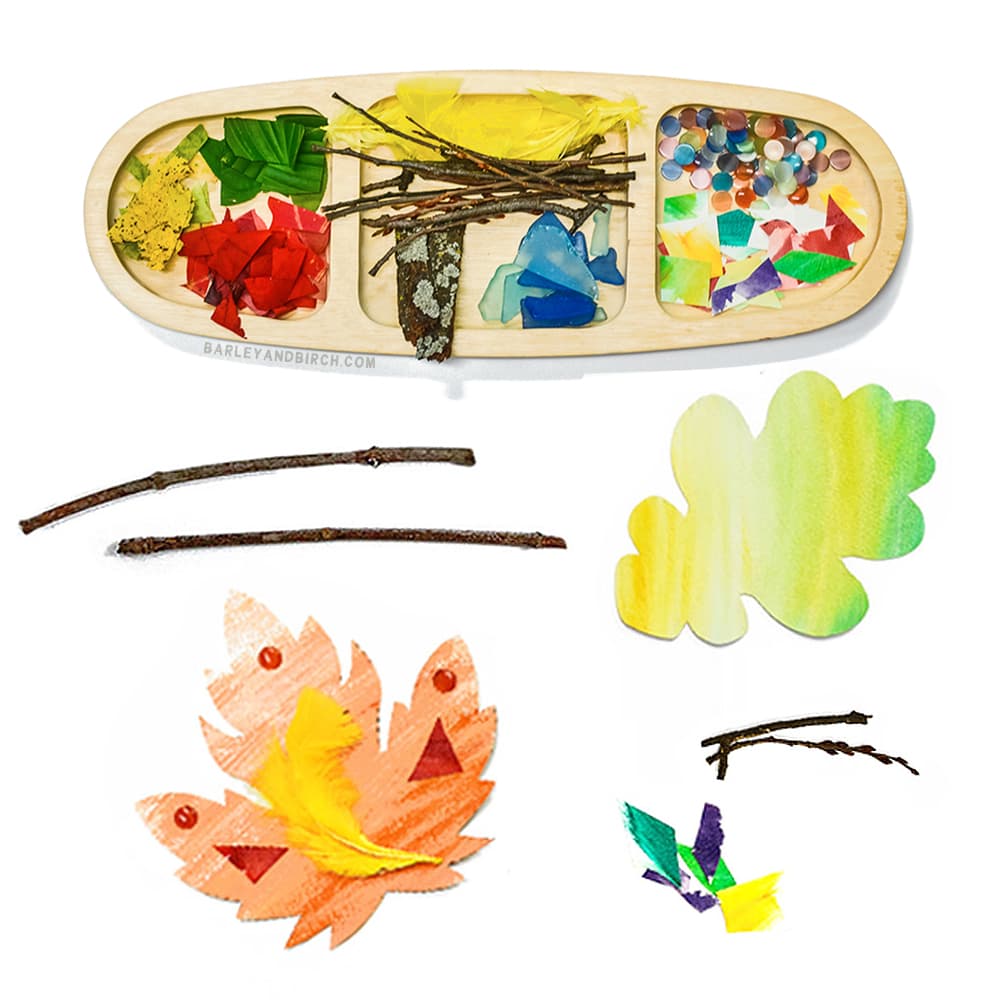
The tray we set out featured some of my favorite natural materials for loose parts play. Leaves, feathers, bark, sticks, and paper scraps offer a variety of textures. Sea glass and cabochons have excellent natural transparency (just check to ensure all your glass pieces have smoothed edges first).
I cut out and watercolored a few of our large leaf templates to act as a “backdrop” for using loose parts to build and decorate, but you can simply print and let your kids color themselves.
Pairing collected leaves and natural materials with kid-safe scissors (as we did for our mouse mail play activity) is a wonderful way to introduce scissor skills and encourage fine motor development.
You can create leaf confetti for use with your loose parts by using scissors or different sizes and shapes of hole punches to cut real leaves into confetti. Collecting a variety of colors makes it all the more exciting to toss into the air or throw on a project!
Using paper tubes, cardboard boxes, or playdough as a building base and leaves, plus a selection of their favorite natural loose parts, invite kids to create animal habitats, hibernation dens (as we did for one of our fall play trays), or small world structures.
Pinecones, straws, spools, pom poms, paper scraps, and more can be stuck in or glued to the structures.
Lay out with paper or fabric scraps, a brayer, and paint on a tray to let kids experiment with printing and stamping leaves. Children can dip the leaves into the paint, place them on white blank paper, or paint them themselves. You can cover paper with office-supply stickers and large leaves, use a brayer to cover with paint, then take off the leaves and stickers for a printing process that helps teach kids about positive and negative space.
When both leaves and sunshine are typically abundant in summer, you can experiment with arranging leaves and loose parts on cyanotype paper to make loose-part leaf sun prints.
For a variation on leaf painting for winter months when natural leaves are harder to come by, I’ve used baking soda to cover the leaves with a coating of “snow.” You can brush on baking soda. After you’re done, you can help your littles rinse with water, squeeze out, and lay on a towel to let fully dry.
Choosing colors inspired by the leaves in your neighborhood or the season’s hues, make your own dyed rice, use dry beans, or make water beads you can combine in a bin with a selection of leaves.
You can add scented pumpkin playdough or items with shades of reds, oranges, yellows, and browns for an autumn leaf sensory bin.
Water interaction with loose parts creates ripples, dripping sounds, and reflections. Water makes particular objects float, and others begin to fall apart. Invite children to experiment with and observe these interactions by providing a bowl or tray and pitcher of water with their loose parts. Simply throwing everything together into a loose parts soup provides provocations to investigate.
Adding leaves to the mix creates outstanding nature associations. Use an eyedropper to gently cover different types of leaves with water. How does the water run off (if it does at all)? Put other items on the leaves now – does the water make them fall off or help them to stick to the leaf surface? Pound or grind leaves with other objects, add water, then observe what happens to the color of the water or leaf pulp.
Though we often think of water play as a spring or summer activity, autumn and winter are fantastic times to freeze leaves (real leaves or felt leaves work well for this!) and incorporate them in a bit of loose parts play. How do frozen leaves interact with other objects and materials when solidly frozen? What happens as they start to thaw?
Using play dough, a cardboard box, or a wood base with small holes drilled into it, insert twigs, then invite kids to decorate with leaves and other loose parts. Small clothespins, clips, or stickers can be used to attach leaves and other decorative items. Beads can be threaded onto the twigs, or a hole punch can be used to punch holes in real or paper leaves and thread them onto branches.
An activity inspired by my early Montessori day, use small vases and bowls to create arrangements of leafy branches, twigs, flowers, and other supplies. Add water, or let dry, and observe to see what happens to the leaves over time and how the arrangement’s colors, form, and overall shape change.
Make colorful mandalas using a variety of leaves and assorted loose parts. This can easily be made into a collaborative activity by inviting one child to create half of the mandala and another child to create the mirror image.
Start with a photo or full-page landscape torn out of a magazine, and let kids build leafy landscapes on top of the image using collected leaves, paper or felt leaves, and loose parts.
Create a still-life scene using leaves and loose parts, then sketch. If using real leaves, you can provide a magnifying glass for a close-up examination.
Here’s an idea that comes straight out of my own college art experiment archive: Tie string or twine onto leaves and an assortment of other loose parts. Tie them all onto a branch, piece of long cardboard, or other material you can hang in front of a window or outside. Using large pieces of paper or newsprint, trace the shadows made at different times throughout the day.
Arrange leaves and other objects on a light box or table and trace for a simpler variation.
Introducing kids to fall nature play becomes more engaging with activities like an easy leaf scavenger hunt, or creating a DIY felt four seasons tree, offering a hands-on approach to understanding seasonal changes.
For more fun kids’ leaf activities try making nature-decorated paper leaf puppets or magic noisemaker leaf wands.
For a preview of a few of the pages of our free printable leaf activity kit and some simple ideas for use, watch the quick video below!
*A note about affiliate links: We strive to use simple, earth-friendly supplies that can be purchased locally whenever we can, but sometimes we find the best universally available options, a rare eco-friendly find, or a niche product only available on Blick Art Materials, Amazon, Etsy, or Woodpeckers Crafts. When included in our supply list, these products are affiliate links, and if you click through to make a purchase we receive a small commission that helps us re-order these supplies!
GETTING READY TO TRY this?
I love seeing all the ways people make these ideas their own! If you're sharing the results of one of our projects, mention or tag me with @barleyandbirch, or share it in the comments of one of our Pinterest project pins.