Dramatic Play . Indoor Activities . Nature-Based Play . Outdoor Play . Paper Crafts and Art Projects for Kids . Sensory Play . STEAM Learning . Summer Activities for Kids
31 Kids’ Creative Prompts for July

Amanda Eldridge
This month we’re taking a little time to encourage bold imagination, wild invention, and joyful summer exploration.
Whether you’ve got a full house of lively kids or a quiet afternoon to fill, these simple prompts can be used to inspire drawing, storytelling, pretend play, or creative builds (all with minimal or supplies needed).
Each day includes a short idea to get your wheels turning and an activity suggestion to help bring your creation to life.
Spend some time inside cooling off or out exploring the great outdoors… there’s a July activity prompt for every kind of day and every kind of kid!
$5.99
A 39-page PDF set optimized for both color and black & white printing.
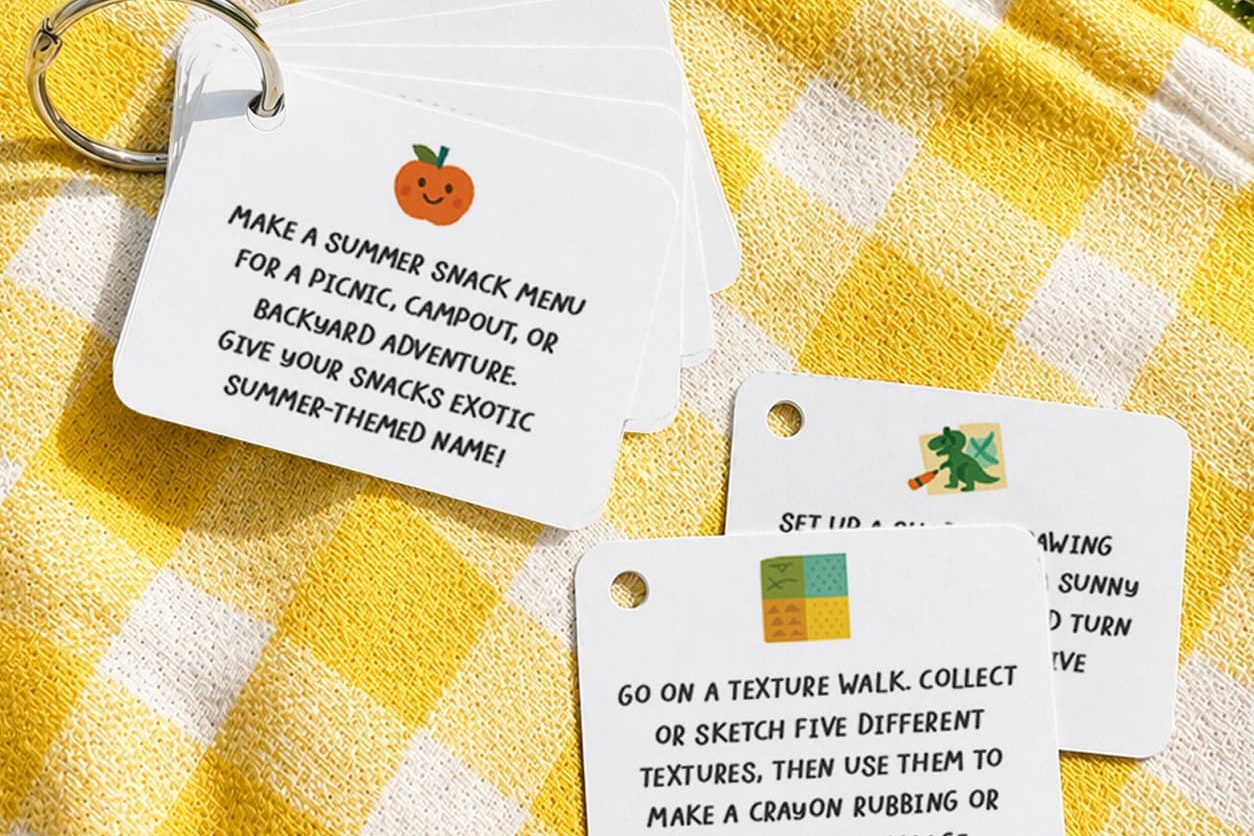
Here are 31 July-themed creative thinking prompts you can pair with July holidays, seasonal observances, historical events, and more…
Design a stamp for someone or something you think deserves to be remembered—but usually isn’t celebrated. Could it be a person, a certain insect, a neighborhood place, or even a fleeting feeling? Think about what it would look like, its colors, and what text might be included.
Use paper, markers…maybe some scrap paper or recycled cardboard (whatever you’ve got!) to create your stamp design.
For an artful twist, carve a potato or sponge stamp, or glue foam shapes to a block and stamp your stamps! Kids can design a “postal wall” to display everyone’s commemorative creations. For younger kids, adults can help pre-cut basic stamp shapes to decorate.
Invent an alien species that only visits Earth during July. What do they love most about this time of year? What strange behaviors or tools do they use? And what evidence of their presence might they leave behind before they return home?
Kids can use foil, playdough, pipe cleaners, or other craft materials to sculpt their alien and its belongings (we actually have some soft sculpture ideas!).
Invite them to create a “field guide” entry with facts about the alien diet, language, or favorite summer activity. For groups, you can turn this into a full alien museum (take us to your di-rec-tor!) or gallery walk.
Pick a common summer item (like a fan, bike, or sunglasses) and redesign it to be completely useless (but in an entertaining or ridiculous way). What does it do? What *doesn’t it do*? How would you sell it to people as the next big thing?
Ask kids to sketch out a product ad, comic strip, or commercial script showcasing their “useless” invention.
Use craft supplies or junk drawer items to build a prototype. Encourage younger children to explain their idea through a puppet show or pretend infomercial.
Write a personal declaration of independence from something you’ve outgrown. It could be a fear, an old habit, or even a food. What are you claiming freedom from, and what will you do instead?
Use tea-stained paper or recycled grocery bags to create official-looking scrolls. Help kids design a symbolic seal or crest with meaningful colors and icons and display them on a wall or read them aloud in a dramatic proclamation ceremony.
Make a deliberate “mistake” on paper – spill something, scribble, rip, or smudge. Then challenge yourself to turn it into something beautiful, funny, or meaningful. How can something imperfect become the heart of your creation?
Set up a “mistake-making” station with paper, markers, glue, scissors, and collage scraps. For younger kids, you can offer prompts like, “What creature lives in this scribble?” or “Can you turn that spill into a landscape?”
Visit a favorite summer place and close your eyes for a full minute to absorb it using all five senses. What do you hear, feel, smell, taste, and see? Capture those feelings in a memory snapshot to revisit later.
At home, invite kids to recreate their snapshot through drawing, a collage using textures (like sandpaper, foil, or fabric), or scent jars with herbs or flowers. Use this as a mindfulness moment or journaling prompt. For younger kids, guide them through each sense verbally before the art-making begins.
Make a self-portrait using only items you’d find in your kitchen. Think utensils, cereal, pasta, napkins, or spice jars. What do your item choices say about you?
Lay a placemat or tray down and have kids arrange their face on it like a sculpture or collage. Take a photo before cleaning up. You can also print out a large picture of their own faces and have kids create compositions over on top (a great variation for younger children).
For another alternative, print some photos of foods and utensils (or cut them from magazines) and create some food-face masks. This is a hit with pretty much any age (especially when paired with a silly photo booth setup).
Design clothes or accessories that make a sound when you move. What kinds of sounds do they make—clinks, scrapes, swooshes? What mood or message does your outfit send?
Use foil, bells, dry pasta, or crunchy paper to build a wearable piece or accessory. Let kids do a sound-themed runway walk and have others guess the theme. For younger kids, try attaching noisy materials to paper hats or capes using tape or glue dots.
Take a walk around your house, yard, or park, and then recreate your journey on the ground using yarn or string. Pretend your path is a constellation and name it!
Give kids yarn, string, or chalk to draw out their trail on the floor or sidewalk. Add natural objects or mini flags to represent special stops along the way. For younger kids, use painter’s tape indoors to build a more visual “guided” version of their “star path.”
Find a rock, tree, or shell and pretend it can talk. What has it seen? How long has it been there? What stories would it tell about people, weather, or the world changing around it?
Have kids sit quietly with their object, then write or record a pretend interview with questions and imagined answers. For younger kids, you can help them “voice” the object as they dictate responses. Add a drawing of the object and a fun fact sheet to turn it into part of a storybook or “Nature Times” article.
Imagine July is a gadget that comes with a user manual. What’s included in the box? What are the safety warnings, common glitches, and pro tips?
Fold paper into a mini booklet and decorate the cover like a real instruction manual. Include charts, sketches, or emojis to explain features like “Warning: Heatwave Mode” or “Activate Poolside Chill.” Younger children can create a poster version with stickers or magazine cut-outs.
Use only sticks, stones, leaves, and other natural materials to create a message that someone 100 years from now could interpret. What will your arrangement say, and how will they understand it?
Lay out natural materials on a tray, sidewalk, or board to spell out shapes or symbols. Take photos and write a “decoder’s guide” explaining the meaning of your design. For groups, have kids swap and guess the meanings before reading the explanations.
Use tracing paper to copy just half or random parts of an existing coloring page. Remove the original, and challenge yourself to invent something new and unexpected to complete the missing parts.
Use tracing paper or fold a coloring page in half to copy one side. After removing the original, let kids draw the rest however they want. Display both versions side-by-side with titles like “The Original” and “The Remix.” Younger kids can start with just a simple shape or face.
Walk through each room in your home as if you’ve never seen it before. What hidden textures, colors, patterns, or tiny details do you notice?
Create a “detective notebook” using folded paper. Draw or jot down your findings like footprints, scuff marks, or secret creaks. Add magnifying glasses or badge props for dramatic play. Great as a group activity with each child assigned a different room.
Have each person in your family secretly wrap 1–3 summer snack items in foil or a napkin. Then guess what everyone brought before revealing and combining the ingredients to make silly new summer foods.
Provide simple ingredients like fruit slices, cheese cubes, crackers, or pickles. After unwrapping, invent snack combinations and name your new recipes. Create a tasting table and a rating chart, write silly reviews like a food critic, or turn it into a pretend cooking show.
Build a Mars rover and imagine it just missed capturing something incredible at the edge of its photo. What almost made it into the frame?
Use LEGO, blocks, or recyclables to build a rover. Then draw or describe the “near miss” in a comic panel or captioned photo. For extra fun, create a whole “mission log” with stories from space, complete with star maps and Martian discoveries.
Draw a familiar place—like your room or backyard—as if it’s dreaming at night. Imagine glowing plants, floating objects, or swirling air. What would your world look like under moonlight magic?
Use dark-colored paper and light pencils, crayons, or chalk for contrast. Add glow-in-the-dark stickers or metallic foil pieces. Turn off the lights and display finished works by flashlight for a dreamy gallery experience.
Make up a silly song using invented words, wild sound effects, and goofy rhymes. Pretend you’re performing it around a crackling summer campfire.
Make paper “campfires” using tissue paper and paper towel tubes. Then perform your song with props, silly hats, or sock puppets. Record your performance or create a camp “songbook” for others to join in. Little ones can add sound effects with instruments or kitchen utensils.
Wrap up in a sleeping bag or big blanket, then stand up and imagine you’re a brand-new creature. What’s your name? What powers do you have?
Create a creature bio with its likes, dislikes, habitat, and favorite food. Let kids draw their new identity or design a “field guide entry.” For multiple kids, turn it into a creature parade or playdate zoo.
Pretend you’re the Moon on July 20, 1969 – the day humans first arrived. What do you remember? How did it feel to be visited?
Fold paper into a diary and write a few journal entries from the Moon’s point of view. Add tiny sketches of astronauts or footprints. Use gray and silver art supplies to decorate. For little ones, create moon faces with chalk and help them describe how the moon might have felt.
Choreograph a dance that shows how hot weather feels—sticky, melty, jumpy, or sluggish. What movement matches the heat?
Play different types of summer music and let kids create “moves” for different temperatures (melting, fanning, jumping on hot sand). Make simple fans from folded paper to use as props. For toddlers, turn this into a freeze dance with a “hot sun” theme.
Invent a miniature Olympic event using paperclips, erasers, or cereal pieces. What’s the challenge? What are the rules?
Set up an Olympic arena with cardboard or trays. Let kids decorate medals, banners, and team flags. Add scorecards and create multiple events like “cereal toss” or “ruler javelin.” Younger kids can do simplified challenges like blowing cotton balls through obstacle courses.
Recreate the sounds of the sea using household items. Can you make waves, splashes, or the creak of a pirate ship?
Give kids bowls of water, fabric, plastic bags, and pots to explore sound-making. Record their performance or create a sea sound guessing game. Preschoolers can simply explore the sounds as a sensory play activity.
Use small toys, nature items, or recyclables to build a coral reef in a bin or kiddie pool. What creatures live there? How do they move?
Fill a shallow tray or container with water and build up a reef using blocks, sponges, toy fish, or natural objects. Act out reef life using movement and sound. Add colored lights or fabric underneath for extra magic. Younger kids can scoop and pour while helping place the pieces.
Imagine a creature that can survive the most extreme summer heat. What features help it stay cool or store water?
Use foil, clay, or paper to sculpt your creature. Make a display label with its name, temperature range, and cooling superpower. Create a habitat diorama using blue or red paper to show extreme environments.
Place three unusual objects in a scene. What mystery do they suggest? What strange event might have just taken place?
Set up a mini scene using random objects—like a toy car, empty cup, and string—and invite kids to invent the story. Draw a comic strip or write a detective report. Younger kids can dictate their story as you write it down.
Experiment with lemonade by mixing in different flavors—herbs, juice, fruit, or spices. What new taste can you invent?
Offer small cups of lemonade and add-ins like basil, mint, strawberries, or cinnamon. Provide a taste test card for naming and rating blends. Create labels for new flavors and display them in a “test kitchen” lineup.
Invent silly solutions to summer annoyances—like sweaty feet or melty ice cream. What crazy gadgets or tools could help?
Kids can sketch invention blueprints or build mini models using cardboard, straws, and tape. Turn it into an invention fair with signs and demonstrations. Younger children can focus on one simple problem and design a tool with clay or blocks.
Use the power of the sun to make art! Place objects on colored paper in the sun and let their shadows “print” a design.
Use construction paper or sunprint paper and place leaves, toys, or cut paper shapes on top. Leave them in the sun for a few hours, then remove the objects to reveal silhouettes. Laminate to turn into placemats or cut them into postcards.
Freeze colored water or juice into cubes and stack them to build a sculpture. What does it look like as it begins to melt?
Freeze colored water in ice cube trays (or try different shapes with muffin tins or silicone molds). Stack them on a tray outdoors and watch as they slowly melt. Take pictures at intervals to document the sculpture’s life. Great sensory fun for all ages!
Build a tiny floating city using foil, bottle caps, plastic lids, or small containers. What kinds of buildings float best?
Use a bin of water to test different building bases, then decorate with flags, labels, or clay characters. Let kids tell stories about who lives there and how the city survives waves or weather. Younger kids can do a float/sink test first with supervision.
This creative sparks series began in June and you can find even MORE summer-themed creative prompt ideas with last month’s collection.
GETTING READY TO TRY this?
I love seeing all the ways people make these ideas their own! If you're sharing the results of one of our projects, mention or tag me with @barleyandbirch, or share it in the comments of one of our Pinterest project pins.